
Reviewed · STREET ART
Melbourne Street Art Quest: Self-Guided Urban Story Game
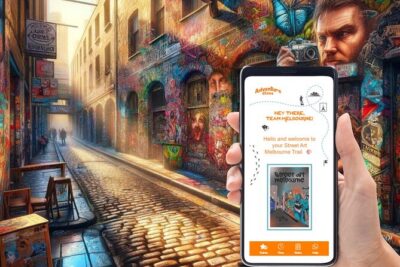
Melbourne’s famous laneways become your game board on this self-guided street art quest. Starting at Hosier Lane, you follow phone-based clues to AC/DC Lane, Meyers Place, Parliament Gardens, and Fitzroy, solving 15 challenges as the city’s murals and public art provide the answers.
I like the low price, just $7.28 per person, and the freedom to pause or restart when it suits you. I also like that the route takes you beyond the best-known Hosier Lane into smaller lanes, a garden, and Collingwood and Fitzroy street art. The catch is that the clues may not always be perfectly current, and one participant found the third challenge confusing. Choose a cool day and allow extra time if you want to take it slowly.
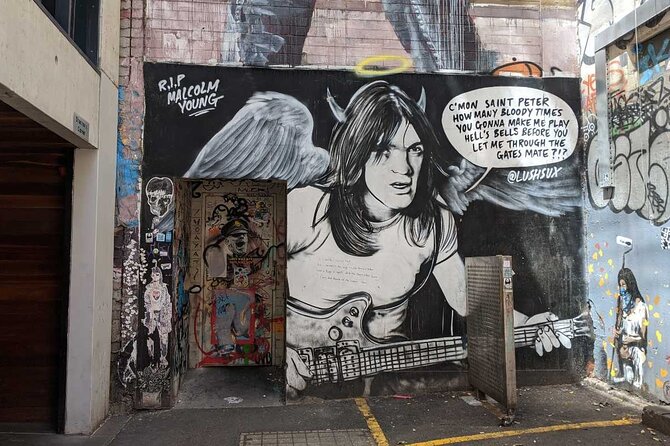
- AC/DC Lane adds a music-history stop beside Cherry Bar and walls covered with music-themed art.
- Fifteen phone puzzles turn sightseeing into a treasure hunt, so you look closely instead of simply walking past.
- The route reaches a surviving Keith Haring mural in Collingwood, a major draw for modern-art fans.
- Meyers Place shows a greener side of Melbourne’s laneways, with its connection to the Green Your Laneways campaign.
- You set the pace, with the option to pause and resume instead of keeping up with a group.
- The route ends in Fitzroy, near the Ceramic seats, after about 1 hour 15 minutes.
In This Review
- How the Melbourne street art quest works
- Starting in Hosier Lane and finding your bearings
- AC/DC Lane brings music to the walls
- Meyers Place and Melbourne’s greener laneways
- Coles Fountain in Parliament Gardens
- The Collingwood Keith Haring mural
- RONE’s Never Enough mural
- Ending near the Ceramic seats in Fitzroy
- What the fifteen challenges add
- The main drawback: clue accuracy and hot weather
- Is $7.28 good value?
- Who should book this experience?
- Booking, timing, and cancellation details
- Should you book the Melbourne Street Art Quest?
- FAQ
- How long does Melbourne Street Art Quest take?
- How much does the experience cost?
- Is a physical tour guide included?
- Do I need a map or GPS?
- Where does the quest start?
- Where does the quest end?
- How many challenges are included?
- Can I pause and resume the activity?
- Is the activity private?
- Can I cancel for a full refund?
How the Melbourne street art quest works
This is not a walking tour with a person leading the way. It is a private activity for your own group, delivered through the Questo app on your phone.
You receive a mobile access code and use the app to follow step-by-step instructions. At each point, you inspect the art, building, fountain, or street details around you, then answer a question, solve a challenge, or guess the response. The next piece of the story appears after you complete the task.
I like this format for Melbourne because the city’s laneways reward close looking. A conventional tour can point out a mural and move on. Here, you have a reason to study lettering, faces, names, and small details that might otherwise pass unnoticed.
The advertised playing time is about 1 hour 15 minutes. That is a useful guide, but it should not be treated as a strict appointment. You can pause and resume at any time, which helps if you want photographs, a coffee break, or a closer look at a piece of art.
The route requires no physical guide, map, or GPS. That keeps the price low and gives you privacy, but it also means you must rely on the instructions and your own phone. If a clue seems unclear, there is no guide beside you to explain it on the spot.
Starting in Hosier Lane and finding your bearings
The quest begins at 3 Hosier Lane, Melbourne. Hosier Lane is a fitting starting point because it is one of the city’s best-known street art locations, with walls that make an immediate impression.
The first challenge asks you to look around and find the answer in the setting. That is the basic rhythm of the whole activity. You are not simply reading background notes on your screen. You are using the physical lane as part of the puzzle.
I recommend arriving with your phone charged and taking a moment to get your bearings before starting. The opening section sets the tone, so rushing through it can make the later clues harder to follow.
Hosier Lane can also be visually busy, with many things competing for your attention. The app’s instructions are meant to guide you step by step, but you still need to read carefully and match the clue to what is actually in front of you.
More street art tours in Melbourne:
- Melbourne Street Art Tour
★ 5.0 · 378 reviews - Melbourne: Street Art Walking Tour with a Street Artist
★ 4.9 · 147 reviews - Street Food & Street Art, Backroads & Boroughs
★ 5.0 · 23 reviews
AC/DC Lane brings music to the walls
From the opening laneway, the quest takes you to AC/DC Lane. The lane was named for the Australian rock band in 2004, and music legends dominate its walls.
This stop has a clear sense of place. It is not just a random alley selected for colourful paint. Its name ties the artwork to Melbourne’s music culture, and Cherry Bar, an iconic music venue, adds another musical reference nearby.
The challenge here asks you to scan the surroundings for an answer. That makes the stop more than a photo break. You will need to read the art and the lane itself, which encourages the sort of attention that works well in a city with a strong street art culture.
For me, AC/DC Lane is one of the strongest parts of the route because it combines a specific local identity with a simple game mechanic. You can enjoy the art even if you are not a major rock fan, but the band connection gives the place a clear character.
Meyers Place and Melbourne’s greener laneways
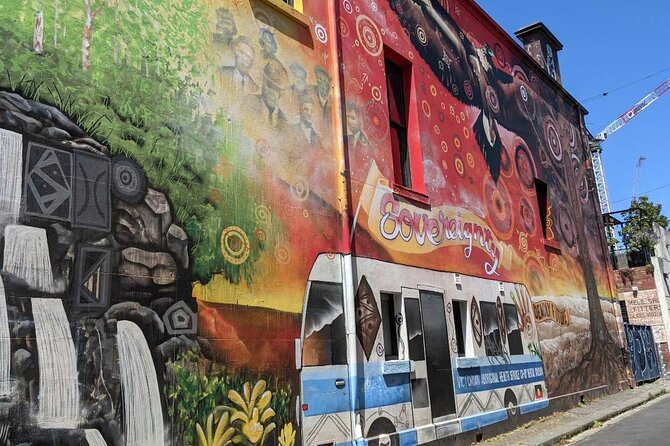
The next stop is Meyers Place, originally known as Nicholas Lane. It links Little Collins Street with Bourke Street in the upper part of central Melbourne.
Meyers Place was selected as one of the pilot projects for the city’s Green Your Laneways campaign. That detail gives you a different way to think about Melbourne’s backstreets. The route is not limited to graffiti walls. It also points to efforts to improve and rethink the laneways as public spaces.
The puzzle format works well here because you must notice the lane’s details rather than assume every answer is painted in giant letters. The setting changes from the strong music identity of AC/DC Lane to a place connected with urban design and greenery.
This is also a practical point in the route. You are moving through central Melbourne rather than being taken to a single fenced attraction. Keep the phone instructions open and pay attention to the next step, since the experience depends on moving between city streets and lanes in the correct order.
Coles Fountain in Parliament Gardens
The quest then reaches Coles Fountain in Parliament Gardens. Here, stainless-steel tubing creates a geometric frame about three metres high, with water cascading into a basin below.
The fountain makes a striking contrast with its historic garden setting. That contrast is exactly the kind of visual change that keeps the route from becoming a string of similar graffiti walls.
The challenge asks you to inspect the area for an answer. This gives the fountain a practical role in the game, but it also encourages you to notice the sculpture as public art in its own right.
I would not treat this stop as filler between laneways. It broadens the experience. You see how Melbourne uses art and design in a garden setting, then compare it with the rougher, more openly painted surfaces in the central lanes.
If you like having variety during a short city walk, this is an important part of the route. If your main goal is only large murals, it may feel less dramatic than AC/DC Lane or the Haring work later on.
A few more Melbourne day trips worth comparing
- Mornington Peninsula Self-Guided Bike Tour | Food & Wine Region
★ 5.0 · 44 reviews - Marvellous Melbourne: A Self-Guided Audio Tour
★ 4.5 · 26 reviews - Self-Guided Street Art Tour in Melbourne with Fun Cryptic Clues
★ 3.5 · 12 reviews - Melbourne Vampire Quest: Self-Guided Gothic Adventure
★ 4.5 · 10 reviews
The Collingwood Keith Haring mural
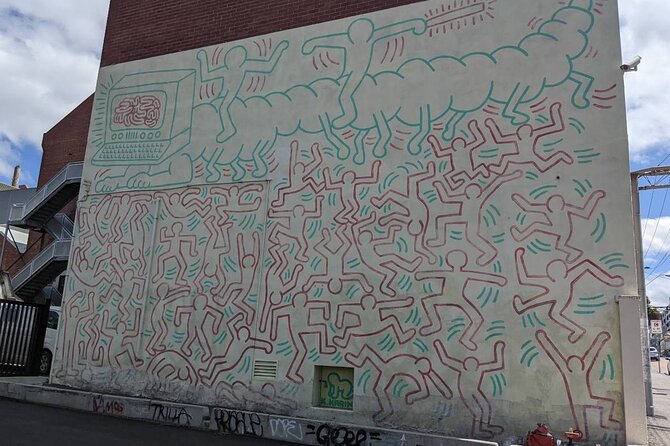
One of the major artistic highlights is the Collingwood mural by Keith Haring. It is one of only 31 known Haring murals still surviving around the world, and one of only three that has not been significantly painted over.
That fact gives this stop real weight. You are not simply finding another local wall covered in street art. You are seeing a rare surviving work by an internationally important artist, with its original presence still largely intact.
The mural also connects Melbourne’s street art scene with a wider modern-art story. Haring’s bold figures and strong graphic style are easy to recognise, but the game asks you to look closely and use the work as part of a challenge.
I would give this stop extra time, even though the full activity is designed to take only about 75 minutes. The app may guide you toward the answer, but the mural deserves a proper look before you move on.
The location in Collingwood also shows how the experience expands beyond the most famous central laneways. You begin in the heart of Melbourne, then reach a different inner-city area where the art feels tied to a broader local neighbourhood.
RONE’s Never Enough mural
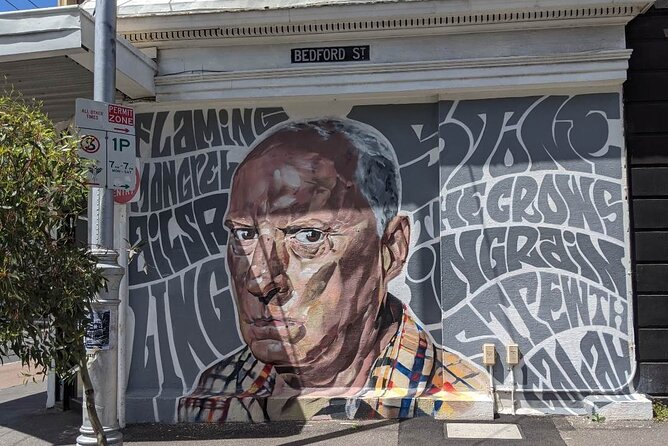
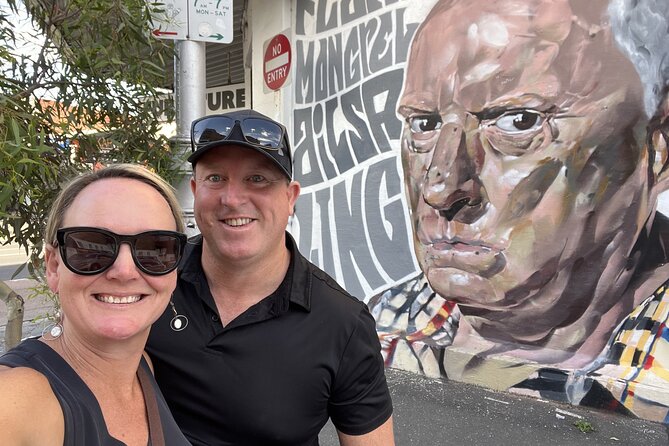
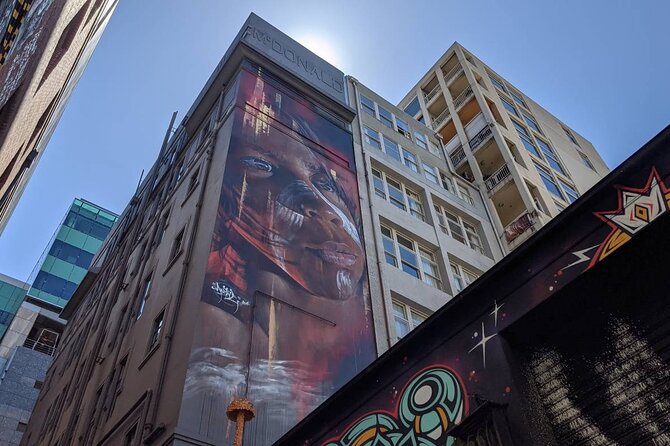
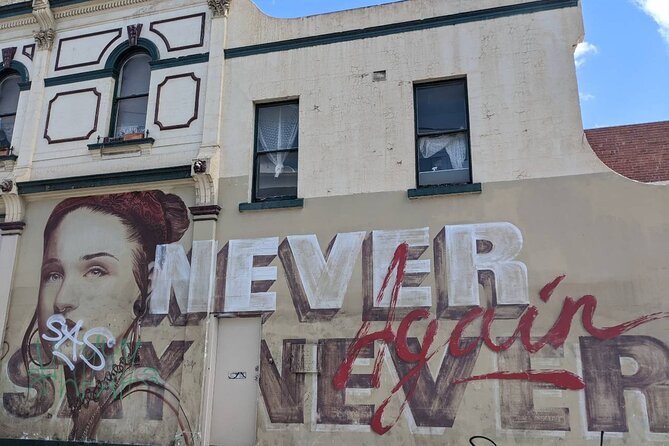
Another featured work is RONE’s Never Enough, a mural showing one of his signature portraits alongside text painted by Wonderlust.
This stop gives the quest a more contemporary visual note. The portrait and wording create a direct, readable image, but the game still asks you to search the surroundings and work out the answer rather than simply telling you what to see.
I like the inclusion of named artists here. The activity is not only about taking pictures of colourful walls. It gives you small points of reference, helping you connect particular works with artists and collaborators.
The clue-based approach can also slow you down in a good way. You may find yourself checking the portrait, the text, and nearby details more carefully than you would on an ordinary walk through Fitzroy or Collingwood.
Ending near the Ceramic seats in Fitzroy
The instructions lead you to the Ceramic seats at the end of the route, at 275 State Route 45, Fitzroy. The app guides you step by step to this finishing point.
The end location gives the activity a clear finish rather than leaving you somewhere in the middle of a lane. It also places the final part of the quest in Fitzroy, an area known within the route for its public art and backstreet character.
The supplied information does not give a full description of the Ceramic seats, so I would treat them as the final meeting point for the game rather than plan the entire outing around them. The main value lies in the route connecting several different art locations.
Because the start is in central Melbourne and the end is in Fitzroy, this is not a circular activity. Plan your onward transport from the end rather than assuming you will return to Hosier Lane. The experience is near public transportation, which helps once you finish.
What the fifteen challenges add
The package includes 15 street-art-inspired puzzle challenges. That is a good number for a short urban activity because it gives you repeated reasons to stop and inspect your surroundings without turning the route into a full-day commitment.
The tasks vary in form. You may need to answer a question, solve a challenge, or guess an answer based on what you see. The story content is woven into Melbourne’s graffiti scene, so the activity aims to connect the individual stops rather than present a disconnected list of artworks.
I find this most useful for people who enjoy a little structure. You still have freedom to set the pace, but the app gives you a clear next step when you might otherwise wonder where to go.
The format is less suitable if you want a detailed lecture about Melbourne art, artists, or local history. A human guide could answer follow-up questions and explain context in greater depth. Questo provides a game and story instead, which keeps things light and active.
The main drawback: clue accuracy and hot weather
The biggest practical concern is that a clue may not always match what you find at the location. One person who tried the activity said the third challenge appeared to have a different answer from the one suggested by the clue and did not finish because the game became hard to keep up with.
That is a small sample of feedback, but it points to a real issue with app-based city games. Street art changes. Paint fades, walls are altered, businesses change signs, and public spaces are never fully fixed. A clue that made perfect sense at one point can become confusing later.
If an answer seems wrong, check the surrounding details carefully before assuming you have made a mistake. You can also contact Questo at [email protected] for assistance. The advertised ability to pause and resume gives you a chance to stop rather than forcing your group to push through a frustrating section.
Weather matters, too. The activity is outdoors, and the available feedback specifically recommends choosing a cool day. Melbourne’s laneways can be pleasant for walking, but standing in the sun while searching for a clue will make the game less enjoyable.
Is $7.28 good value?
At $7.28 per person, this is a low-cost way to spend about 75 minutes seeing several parts of Melbourne. The price includes mobile access to the game, the 15 challenges, and the story content. It does not include a physical guide.
I think the value is strongest for a couple, family, or small private group that wants a defined activity without paying for a full guided tour. Group discounts may improve the cost for larger parties, although the exact discount is not stated.
The price also makes the flaws easier to accept. You are not paying for a long, expert-led art tour. You are paying for a self-guided game that sends you to selected places and gives you a reason to look closely.
Still, low cost does not remove the need for preparation. Bring a charged phone, allow some spare time, and remember that the route may take longer if you stop for photos or need to work through a difficult clue.
Who should book this experience?
I would recommend it to:
- People who enjoy puzzles, scavenger hunts, and phone-based games
- Couples or families wanting a private activity
- First-time Melbourne visitors who want to see several central and inner-city art areas
- Repeat visitors looking for a different way to explore familiar laneways
- Independent walkers who do not want to follow a guide’s fixed pace
I would be more cautious about recommending it to anyone who wants a serious art lecture or guaranteed clue support at every stop. The game gives you an entertaining framework, but it does not replace a specialist guide.
Most travelers can participate, and service animals are allowed. The activity runs every day from midnight to 11:30 p.m. during the published operating period, so you have broad scheduling freedom. The listed rating is 3.7 from three ratings, which suggests a mixed but not disastrous picture. I would read that alongside the specific warning about clue accuracy rather than treating the number alone as decisive.
Booking, timing, and cancellation details
You receive confirmation at the time of booking, along with the mobile access code needed to begin. The activity is private, so only your own group takes part.
The stated start point is 3 Hosier Lane, while the finish is near the Ceramic seats at 275 State Route 45 in Fitzroy. The route is not presented as a round trip, so plan your next stop from Fitzroy.
Free cancellation is available if you cancel at least 24 hours before the scheduled start time. Cancellations or changes made less than 24 hours ahead are not accepted for a refund, and the cut-off follows Melbourne local time.
Should you book the Melbourne Street Art Quest?
Book it if you want a cheap, flexible street art walk with a game attached. The route covers more than one famous lane, includes AC/DC Lane, Meyers Place, Coles Fountain, a rare Keith Haring mural, and RONE’s Never Enough, then finishes in Fitzroy.
I would choose a cool day, start with a fully charged phone, and allow more than the advertised 1 hour 15 minutes if your group likes photos or needs time to solve clues. If you can accept the possibility of an unclear or outdated question, the $7.28 price is easy to justify.
Skip it if you need a live guide, detailed art interpretation, or a perfectly polished route with no chance of confusion. For independent explorers who like a little challenge, it is a practical way to turn Melbourne’s laneways into an active afternoon outing.
FAQ
How long does Melbourne Street Art Quest take?
The experience takes approximately 1 hour 15 minutes.
How much does the experience cost?
The listed price is $7.28 per person. Group discounts are available.
Is a physical tour guide included?
No. This is a self-guided activity delivered through the Questo app.
Do I need a map or GPS?
No map or GPS is required. The app provides step-by-step instructions.
Where does the quest start?
It starts at 3 Hosier Lane, Melbourne VIC 3000, Australia.
Where does the quest end?
It ends at 275 State Route 45, Fitzroy VIC 3065, Australia, near the Ceramic seats.
How many challenges are included?
The experience includes 15 street-art-inspired puzzle challenges.
Can I pause and resume the activity?
Yes. You can pause and resume the quest at any time.
Is the activity private?
Yes. It is a private activity, so only your group participates.
Can I cancel for a full refund?
Yes, if you cancel at least 24 hours before the scheduled start time. Cancellations and changes made less than 24 hours before the start are not accepted for a refund.
Recently added around Melbourne
- Great Ocean Road: Kayaking with Seals Tour★ 4.6 · 3 reviews
- Happy Slam Australian Open Melbourne Sports Experience★ 5.0 · 3 reviews
- Coastal Magic – Melbourne 12 Apostles & Beyond★ 4.0 · 3 reviews
- From Melbourne: Mornington Peninsula Hop-On-Hop-Off Bus★ 5.0 · 3 reviews
- Werribee Mansion & Sovereign Hill Tour★ 3.7 · 3 reviews
- Bellarine Winery: Texas BBQ Platter Lunch with Wine★ 3.0 · 3 reviews
- Great Ocean Road Private Day Tour★ 5.0 · 3 reviews
- Melbourne City & Brighton Beach Boxes Helicopter Tour★ 4.5 · 3 reviews
Street Art, compared.
Self-Guided Street Art Tour in Melbourne with Fun Cryptic Clues
Read our review →
Melbourne Street Art Tour with a Local: Private & Personalized
Read our review →Browse the lists this tour appears in